Athlete Bloodwork: Why “Normal” Lab Results Aren’t Always Enough
This week’s themes
The most useful athlete bloodwork papers from mid- to late November are less about a brand-new marker and more about how we read the ones on the panel. A new perspective argues that population lab ranges were never designed to judge whether an athlete has enough iron or energy for training, while original studies show how ferritin, muscle-damage enzymes, and inflammatory signals move with load, and how often low energy availability still goes unrecognized.
Reading athlete bloodwork
“Normal” is not the same as sufficient
Kaneko, Frontiers in Nutrition, November 18, 2026
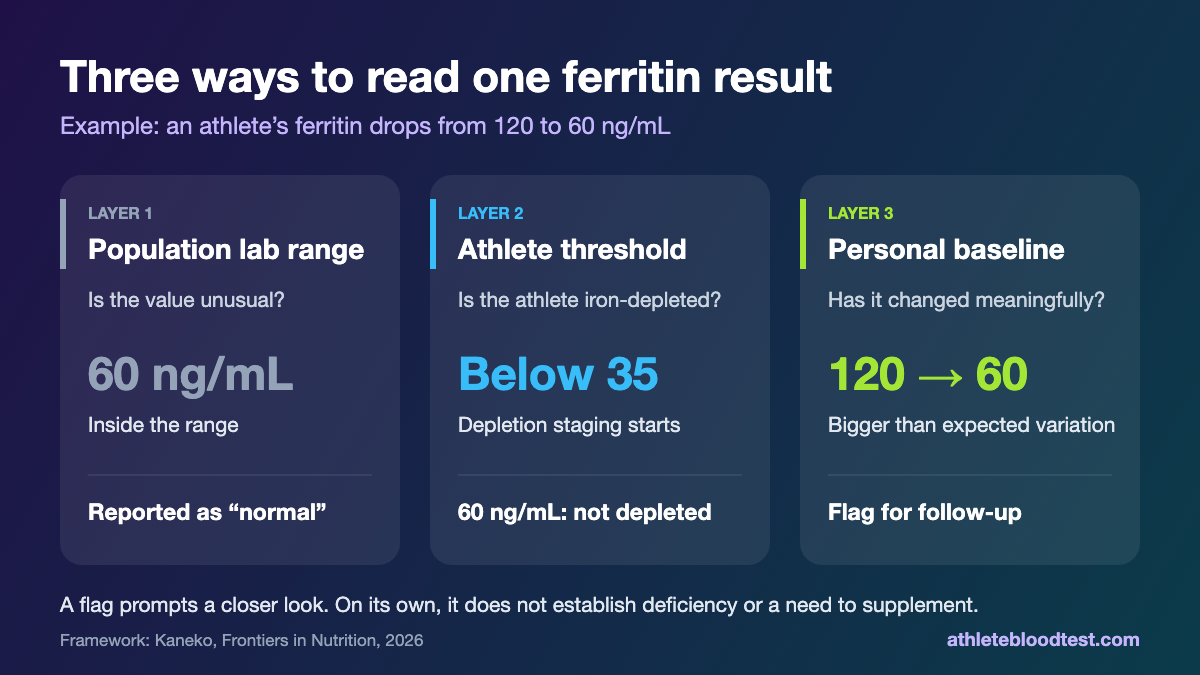
Population reference intervals fail athletes in two directions, Kaneko argues. Training physiology such as plasma volume expansion, muscle damage, and hemolysis can push healthy values outside the range, while true insufficiency can sit inside it. A ferritin of 25 ng/mL, for example, may be reported as normal because it falls within a population interval in which iron deficiency is common. He proposes three layers of interpretation: the population range, which flags unusual values; purpose-defined thresholds, such as athlete iron-depletion staging that begins at ferritin below 35 ng/mL; and a “nutritional passport” that compares an athlete with their own baseline. In a worked example, a drop from 120 to 60 ng/mL may breach neither the lab range nor a deficiency cutoff, yet exceed a typical reference change value. That flag means the change is larger than expected variation. It does not, by itself, establish deficiency or a need to supplement.
Why it matters: A single result stamped “normal” is not a monitoring plan. Standardized timing, an individual baseline, and the training context all belong next to the number.
Iron, energy availability, and female athletes
Ferritin fell as training ramped up in elite artistic swimmers
Ten elite Chinese female artistic swimmers completed a one-week taper and then a four-week intensified block. Low energy availability was present in 40 percent of the athletes during the taper and 60 percent during intensified training. Across the group, exercise energy expenditure and thyroxine (T4) rose, while ferritin and calcium intake fell. The authors concluded that energy intake did not rise with the extra training demand, and they caution that the biomarker changes could not be attributed specifically to low energy availability. The sample is small.
Why it matters: Ferritin can move across a training block even in a tightly supported elite group. Iron studies are easier to interpret against current load, intake, and the athlete’s own baseline.
Most elite female volleyball players had never heard of RED-S
Bicici Ulusahin and Ozkutlu, Sports Health, November 11, 2026
In 148 athletes from the Turkish Women’s Elite Volleyball League, 25 percent were classified as at risk for low energy availability on the LEAF-Q (score of 8 or higher). Fully 92.6 percent reported never having heard of RED-S or the Female Athlete Triad. Athletes at risk were substantially more likely to have sustained an injury in the previous year (odds ratio 7.86; 95 percent confidence interval 3.03 to 20.41). This was a cross-sectional survey, so it shows an association, not that low energy availability caused those injuries.
Why it matters: The knowledge gap is still wide, even at the elite level. Bloodwork can support a fuller clinical assessment when low energy availability is suspected, but it does not replace that assessment.
A chokeberry supplement changed short-term iron signals, not iron stores
Twenty-two adolescent female competitive swimmers (mean age 13.1 years) were randomized to anthocyanin-rich black chokeberry or placebo for about 57 days. After a swimming test, hepcidin rose significantly only in the placebo group. Ferritin did not change, and hematological measures showed no consistent between-group differences. The authors suggest the supplement may influence short-term post-exercise iron availability, without detectable effects on iron stores or red-cell production.
Why it matters: Iron and hepcidin can shift within hours of a hard session. An immediate post-workout iron panel is a poor snapshot of stores.
Muscle damage, inflammation, and the season

CK almost doubled right after a women’s football match. CRP did not.
Bakay, Arslan, Şanlı, and Çelik, BMC Sports Science, Medicine and Rehabilitation, November 20, 2026
Seventeen second-division female football players (mean age 17.5 years) gave blood about 24 hours before an official match and again 15 to 20 minutes after the final whistle. Creatine kinase rose from about 128 to 239 U/L, and AST and ALT also increased, but C-reactive protein and glucose did not change significantly. The authors note that CK often peaks 24 to 48 hours after a match, so this immediate sample captures only the start of the response. The study is small, and match load was not standardized.
Why it matters: A rise in CK immediately after a match is an expected acute response, not, by itself, a sign of overtraining. Timing the draw, and comparing it with the athlete’s usual values after similar matches, matters more than a single number against a general lab range.
In elite soccer, pre-season IL-6 and CK rose as sprints slowed
Silvestri, Cardinali, Marcelli, and colleagues, Journal of Human Kinetics, November 12, 2026
Twenty-one players from Ternana, in Italy’s second-highest division, were tested before pre-season, after pre-season, and mid-season. After pre-season, 10-meter sprint time slowed from 1.68 to 1.78 seconds, repeated-sprint ability worsened, and creatine kinase, lactate dehydrogenase, and interleukin-6 all rose, with mean IL-6 increasing from about 18 to 83 pg/mL. By mid-season, sprint times had recovered, aerobic fitness from the Yo-Yo IR2 had improved, and IL-6 had fallen back toward baseline. Larger IL-6 increases between those two points went with slower repeated sprints. The authors suggest IL-6 may help staff gauge how well players are tolerating load, while recognizing it is not a stand-alone diagnosis.
Why it matters: Season phase changes the meaning of the same marker. A CK or IL-6 value at the end of a heavy pre-season block should not be read the same way as a mid-season result after better recovery.
The takeaway
The through-line this week is context. A “normal” flag on a lab report is not a sufficiency check. Ferritin, creatine kinase, IL-6, and energy-availability screens all move with training load, sampling time, and the individual athlete. Trends against a standardized baseline, together with how the athlete is fueling, recovering, and performing, beat one-off numbers.
Athlete Blood Test works with athletes, coaches, and performance staff to put biomarker results in that broader picture. If you want to talk through a monitoring approach for your athletes, visit athletebloodtest.com.
Related reading: Are these blood results normal for athletes? · Why should athletes care about ferritin levels even if they are not anemic? · Optimizing Athletic Performance: Blood Analysis for Sports RDs